Checkpoint and Respawn Design in Horror Obbies
Horror obbies must choose between player comfort and genre atmosphere.
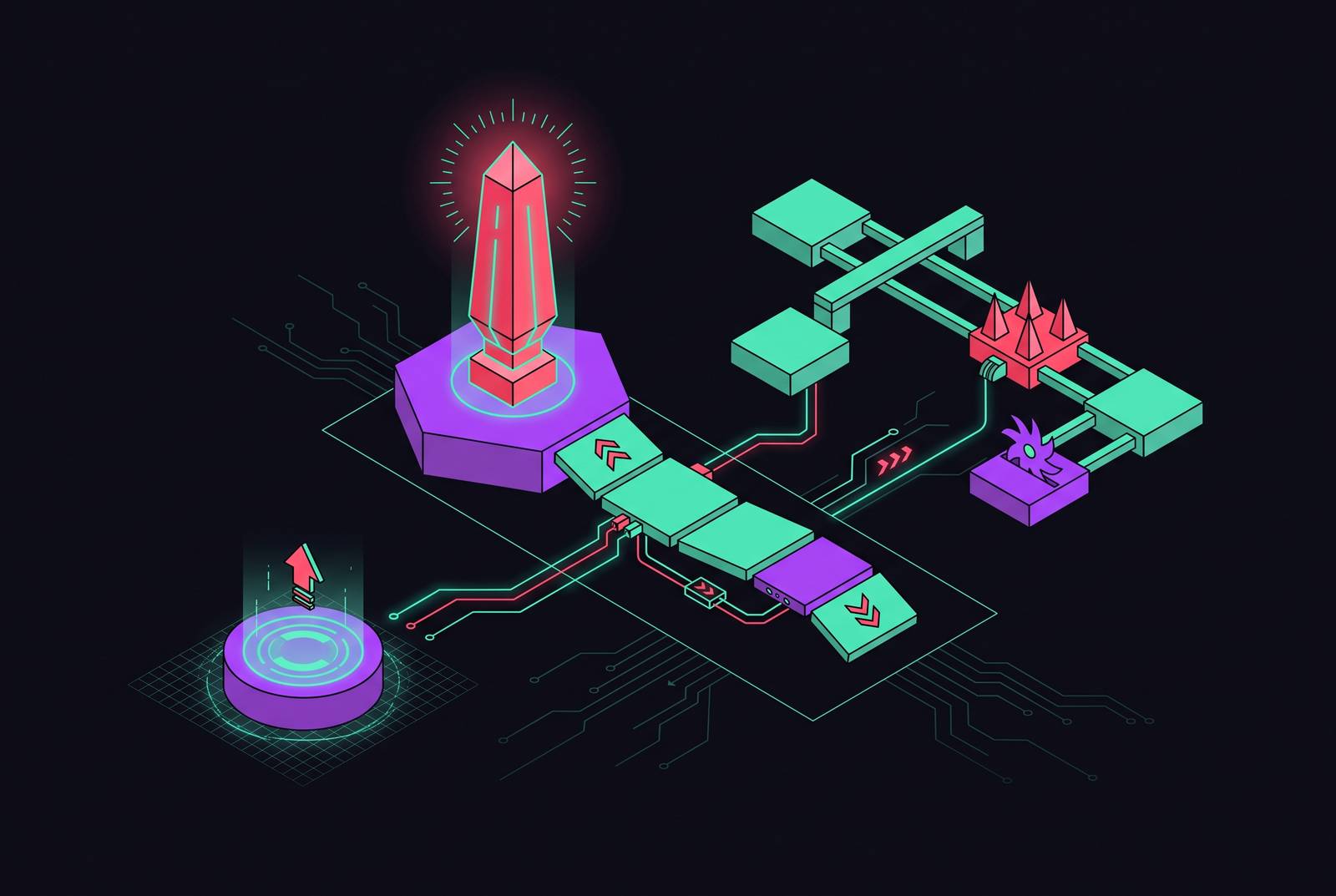
Horror obbies ask two genres to share one body, and the two genres want opposite things. An obby wants momentum, a sense of climbing, a player who keeps moving forward. Horror wants dread, a sense of exposure, a player who never quite feels safe. Standard obby doctrine was built for the first goal: space checkpoints so a death costs only seconds, keeping players in flow. That rule works fine for a parkour tower or a speedrun map. The fix for obby frustration is the same move that kills horror, so it breaks the moment you bolt a monster onto the hallway. A checkpoint that efficiently restores a player also efficiently restores their sense of security, and that security is the exact thing the section before it was built to destroy.
What a checkpoint actually controls, and why the respawn moment is a horror tool
A checkpoint is doing three jobs at once, whether the designer notices or not. It decides how much of a failed attempt gets erased. It decides how often a player gets to exhale. And it decides what mental state the player is in when they open their eyes again after dying. That third one gets ignored constantly, which is strange, because it's the one horror cares about most.
Think about the respawn moment itself, not as a loading screen to speed through, but as a beat in the scene. A respawn delay of zero keeps the pace snappy, which is great for a standard obby and a little insulting for a horror one. A longer delay opens up room for a black screen, a flicker, a held breath, before the player reappears, giving the designer a literal dial between "obby-fast" and "horror-heavy." An instant teleport tells the player death doesn't matter here. A slow, dark respawn tells them it mattered a lot, and that it might happen again. The strongest case against fast respawns comes straight from how good horror actually works. The genre runs on tension and anticipation more than jump scares, and a death with zero cost eventually trains the player out of fearing anything.
Spacing Checkpoints Too Far Apart Destroys Fear
The instinct makes sense on paper: fewer checkpoints, more danger, more fear. Withholding checkpoints doesn't preserve dread in the mechanical way the instinct assumes; it converts it into frustration, and frustrated players don't grit their teeth and push on. They close the tab.
Fear needs a player who believes they have something to lose. That's the whole engine. A player staring down a monster with twenty minutes of unsaved progress behind them is furious at the game for putting them in this position again, not scared of the monster. Picture the classic horror obby setup: a monster tuned to move just a hair slower than a sprinting player, close enough that getting caught feels possible, far enough that escape feels earnable. That calibration only pays off if the player is emotionally invested in not getting caught. Run them through the same stretch four times because the last checkpoint sat half a level back, and that investment evaporates. An unbeatable monster just frustrates people, and a slow one stops feeling like a threat. The thing only reads as dangerous when the player has something worth protecting from it. Putting the checkpoint right before the encounter loses the dread that should build on approach, and putting it too far back makes repeated catches stop feeling scary and start feeling like punishment. The designer's actual job sits in the gap between those two failures: find the spacing where losing still stings, but not so much that trying again feels pointless.
How checkpoint visibility choices trade player experience clarity for atmosphere
Spacing is one dial. Visibility is a completely separate one, and it comes with its own trade-off. Standard obby doctrine says checkpoints should be obvious: a glowing pad, a flag, a platform painted a color nothing else in the level uses. Touching one should feel like a small, unmistakable win. That clarity is a feature in a normal obby.
In a horror obby, that same clarity is a leak. A checkpoint you can spot from thirty feet away announces "you are safe here," and that message doesn't sit well next to "you are never safe here," which is the whole premise of the genre. So the designer is stuck choosing between two ways to get it wrong. Make the checkpoint invisible or ambiguous, and tension survives, but players might not realize they've saved at all, which produces the exact same frustration sparse spacing does, just discovered later and worse. Make it visible, and players always know where they stand, but the horror experience now has clearly marked rest stops breaking up the dread on a schedule the player can predict. Neither option is free. The fix isn't picking a side, it's folding the signal into the horror aesthetic itself, a flicker of light or a brief sound cue that tells an attentive player "saved" without ever telling a distracted one "safe zone."
The Third Layer of Persistence in Narrative-Driven Horror Obbies
Everything above deals with a single death inside a single play session. Chapter-based horror obbies have a second problem layered on top, one that has nothing to do with dying and everything to do with logging off.
Basic checkpoint systems save position in server memory only. The player leaves, the server cycles, and the progress goes with it. For a short single-room horror experience, that's a shrug. For a chapter-structured horror obby, it's a structural failure, because a player who gets bumped back to chapter one after reaching chapter four hasn't just lost level progress. They've lost the story context that made chapter four frightening. Showing up at a scare with no memory of the build-up that earned it isn't horror, it's just noise.
The fix runs on two tiers. Items and keys picked up inside a single run can live in memory and reset when the session ends, and that reset can even be a deliberate design choice, forcing the player to re-gather resources each time through. The chapter or stage reached needs to persist to a DataStore, so a player who rejoins days later lands back at their narrative position. Survival horror offers a useful parallel here, outside the obby format. Games like 3008 use a day/night cycle as a structured safe period, functioning as an implicit checkpoint without ever breaking immersion, and that structure seems to encourage longer, more continuous play. The lesson travels well: a safe moment woven into the world holds up better than a checkpoint bolted onto it.
Building the tension arc: sequencing checkpoint spacing to cycle dread
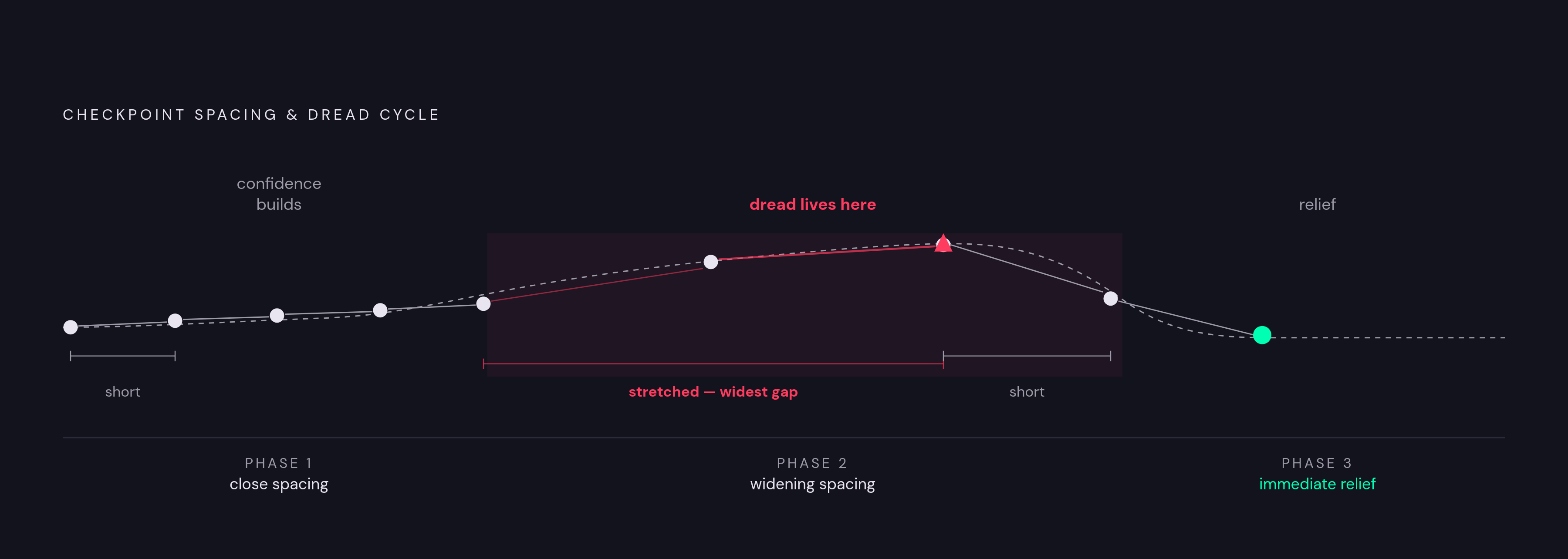
Dread isn't a flat line you hold steady for twenty minutes. Good horror cycles, tightening and releasing on purpose, and checkpoints are the main mechanical lever for scheduling that cycle on purpose.
A working tension arc doesn't space checkpoints evenly. It varies the interval on purpose, stretched across three phases.
Early in a chapter, checkpoints sit close together. This builds confidence fast, and a player who's made visible progress is a player who now has something to lose, which is the raw material every later scare depends on.
As the chapter closes in on its scariest section, the spacing widens. The player carries whatever tension they've built straight into the moment of highest threat, and that accumulated weight is what makes the moment land.
Right after that peak, a checkpoint appears and closes the loop. The relief of saving here is the payoff the whole cycle was building toward.
Enforcement mode matters too. Sequential checkpoints, the kind that force players through chapters in strict order, suit narrative horror where the story depends on sequence. Non-sequential checkpoints fit exploration sections, where letting players wander deepens the atmosphere.
Respawn pacing should track the arc as well. A quick fade suits the tighter, early-chapter stretches where momentum is still the point. A longer, darker transition belongs in the high-threat zone, where the death itself is meant to carry weight, not just reset a position.
There's a simple test for whether any of this is working. Ask a player to describe what they felt in the section they just failed. If they can name a specific fear, something they were afraid of, not just that the section was hard, the checkpoint placement is doing its job. If all they can offer is "that was annoying" or "that took forever," it isn't.
How AI-assisted creation changes who can iterate on checkpoint design
Building the system described above used to require actual scripting knowledge, which kept a lot of people out of the genre. That barrier has dropped. Browser-based AI creation tools can now generate the environment, the objects, and the basic logic from a plain-text description, horror obby included, multi-level structure and all.
That shift moves the bottleneck somewhere new. Quality in horror obbies used to be capped by technical execution. Now it's capped by design judgment. Type "a spooky maze with three levels and a boss fight" and a tool can hand back a working structure in minutes. What that structure can't generate for you is the checkpoint spacing, the visibility calls, the respawn timing: the deliberate choices that turn a technically functional maze into something actually frightening. Those remain deliberate decisions, made by a person who understands the trade-offs this piece just walked through.
The accessibility shift is a genuine net positive for the genre. More people can walk into horror obby creation without a coding prerequisite standing in the door, and that expands who gets to try, which raises the ceiling on what the genre can become. None of that changes the fact that an atmospheric, beautifully lit horror obby with broken checkpoint design will still bleed players. Atmosphere gets someone in the door. Checkpoint logic decides whether they stay.
What the horror obby creator risks if checkpoint design remains an afterthought
Get checkpoint design wrong and a horror obby fails on two fronts at once, not one. Getting checkpoint design wrong leaves a horror obby not scary enough to hold up against the horror games players are mentally comparing it to, and not smooth enough to keep the obby crowd who came in expecting a fair, well-paced climb: too frustrating for the horror audience, too frightening in the wrong ways for the obby audience, satisfying neither.
None of that has to happen. Checkpoint and respawn design is the mechanism that decides whether everything built before it actually lands, whether the monster, the lighting, the sound design, the whole carefully built atmosphere, gets to land the way it was meant to. Get the spacing, the visibility, and the persistence right, and the scares the rest of the game spent so much effort building finally get to work the way they were always supposed to.