Monster Speed and Player Speed Balancing in Horror Obbies
Balancing monster and player speed is the core problem horror obbies actually need to solve.
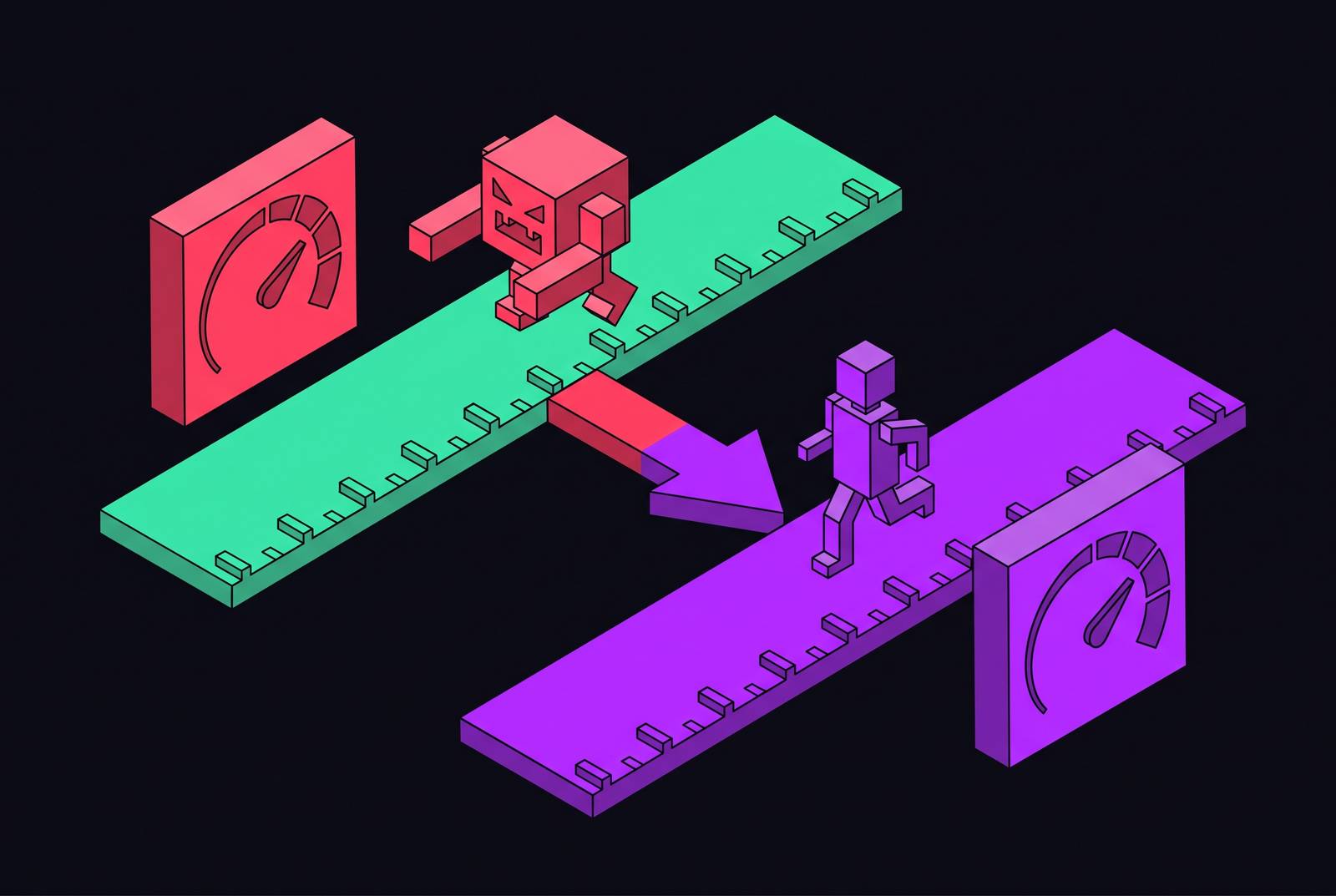
A horror obby is not just an obby with a scary skin on it. The moment a pursuing agent gets added to the map, the whole math of the genre changes, because now there are two moving speeds in play at once instead of one, and the relationship between them becomes the main thing the player is actually fighting. A vanilla obby only asks whether the player can clear the course on their own clock. A horror obby asks something harder: can the player clear the course while something else is deciding how much clock they get? That second question is the one this piece is built around, and it is the one most creators underbuild for.
The speed gap between monster and player controls everything else
The gap between monster speed and player speed sets the outer limit on what every other design choice in a horror obby can accomplish. None of that fixes a monster that always catches the player, and none of it fixes a monster that never does. Atmosphere decorates the chase. Speed differential decides whether the chase is a chase.
Developer discussion of horror obby balancing backs this up in a specific way: when ability cooldowns are too short, a survivor who gets spotted is, in the words of one forum thread, "guaranteed to die." Secondary systems like cooldowns, power-ups, and stamina drains can push the speed relationship in one direction or another, but they cannot rescue a relationship that's broken at the root. If the base speed gap is wrong, every other system just amplifies the wrongness faster.
The single-stud margin, what the numbers look like in practice
Developers who build these games for a living tend to land on a surprisingly small number: one stud per second separating monster from player, at each movement mode. Not five. Not ten. One. And that tiny margin is precisely why a lot of horror obbies feel broken in ways their creators can't diagnose. Moving the number by two or three studs in either direction changes the whole game's character.
That single stud keeps escape mathematically possible at every moment, but it's never a guarantee, which is the exact tension a horror obby is supposed to produce.
Stamina is what turns that one stud from a fixed outcome into a live decision. The speed differential isn't a static fact about the game. It shifts constantly based on choices the player makes under pressure, which is the entire point of putting a stamina bar in a horror game to begin with.
Going too wide in the monster's favor turns escape into a mathematical impossibility dressed up as a game mechanic. Players figure this out fast, usually within a run or two, and once they do, the chase stops meaning anything. Going too wide in the player's favor turns the monster into a glorified hallway decoration: the horror atmosphere collapses under its own uselessness, and the game quietly becomes a parkour course that happens to have a creature standing in it.
How atmosphere inflates perceived monster speed
Players don't perceive monster speed the way a speedometer would report it. They perceive it through everything surrounding it. A well-dressed slow monster can feel scarier than a bare fast one. But on stress, and on how difficult the game felt overall, the slower horror-coded enemy performed just as well, sometimes slightly better.
That finding hands creators more room than the raw numbers suggest. A monster's WalkSpeed can come down a notch if the atmosphere around it is actually doing its job. The catch is that the atmosphere has to be real work, not decoration layered on after the fact. Stripping the fog and killing the audio cue makes that same monster speed look exactly as slow as it is, because the number was never the thing scaring anyone. It was the number plus the dark.
A lot of beginner miscalibration quietly starts here too. Now the speed is wrong in the other direction, overcorrected for a problem that was never about speed to start with.
The pacing trap: what happens when tension never releases or never builds
Even a flawlessly tuned speed gap falls apart if the chase itself is poorly timed across the session. Horror runs on a cycle: tension has to build, and then it has to release. Skipping either half collapses the whole thing regardless of how carefully the WalkSpeed numbers were set. Analysis of horror game design states it directly: there has to be a build up followed by a release, and horror doesn't work if a game only does one of the two.
A monster that's constantly on the player's heels never lets tension build, because the player has no quiet moment to dread what's coming next. A monster that appears so rarely it might as well not exist is the opposite failure. Players calm down, stop scanning corners, stop caring, and the threat turns into ambient set dressing.
In a horror obby, this is really a question of how often the chase gets triggered, not how fast the monster runs once it starts. The speed differential sets the ceiling on how intense any individual chase can get. The pacing of when those chases happen sets the floor on how scary the game feels in between them. Developer feedback on games in testing documents exactly this kind of breakdown, including cases where a hiding mechanic stopped working correctly after a restart, and that failure guts the release half of the cycle just as badly as a monster that never appears.
Three failure modes and player behavior
Three distinct failure patterns occur in horror obby testing, and each one produces a different, predictable player behavior.
The first is the monster that always catches the player. Developer feedback on one horror obby in testing described invisible walls as a problem that "frustrates players and results in lower play time (and a worse like-dislike ratio)," which is about as direct a line from design flaw to player exit as it gets.
The second is the monster that never catches the player. Here the failure is quieter but just as fatal: horror collapses into parkour. The creature stops functioning as a threat and starts functioning as scenery. Players who came for horror leave disappointed, and the players who stay are stuck playing a vanilla obby they never signed up for.
The third failure mode is behavior that's unpredictable without being readable, and it's the most dangerous of the three because it disguises itself as difficulty. Horror depends on a basic fairness contract: players need to understand the objective, read the monster's behavior, and trust that hiding spots work the way they're supposed to. When that contract breaks, the game feels hard, but it's a kind of hard that can't be learned from, no matter how many times someone replays it. That produces the worst retention numbers of all three failure modes, because players can't improve their way out of a system that isn't playing fair.
Asymmetric designs where a faster monster is correct
The "monster just under player sprint speed" rule holds for one specific design shape: chases built on direct line of sight.
Picture a monster that can only see through thick fog a short distance ahead. Setting that monster at the standard "slightly slower" speed means it will almost never catch anyone, because the fog is already doing the balancing work that speed normally handles. The monster needs extra speed to make up for what its own limited senses are giving away. A sprawling map full of blind corners reduces how much ground a monster effectively covers, the same way fog does, so a designer working a large maze should push speed upward compared to what they'd use on a short, straight corridor.
Speed differential has to be set relative to the monster's perception range and the map's geometry, not decided in a vacuum. The one-stud-slower baseline is the right starting point for standard visibility on a standard-sized map. It was never meant to be a universal constant, and treating it like one is how asymmetric designs end up broken.
What readability and fairness require at first contact
A perfectly calibrated speed gap is wasted on a player who hasn't yet learned how to move, where to hide, or what rules the monster is playing by. The chase can only be judged fair if the player had a real chance to learn the game before it started chasing them.
Horror's fairness contract has a few non-negotiable parts: the player needs to understand the objective before any threat shows up, enemy behavior needs to stay consistent and readable, hiding mechanics need to work the way the player was told they would, and there needs to be enough runway to learn the controls before the first chase begins. The player ran into invisible walls while trying to read the environment and figure out where to go next.
None of those problems trace back to a bad speed differential. They trace back to a player who couldn't read what was actually happening, which made a fair chase feel unfair regardless of the numbers underneath it. The same feedback flagged an audio cue, a knocking sound, that was "too quiet to distinguish from ambience." The fix here isn't a speed adjustment at all: design the opening stretch of the game so the player has walked around, tested the hiding mechanic, and heard a working audio cue before the monster ever triggers. Only after that groundwork is in place does the speed differential actually get tested under conditions that are fair to judge it by.
How AI tools scaffold a horror obby in minutes
AI-assisted creation tools have cut the time it takes to get a working horror obby into the world down from weeks to minutes, a genuine shift worth taking seriously.
What these tools can't do is auto-tune the speed differential to a specific map's corridor length, a specific player base's skill level, or the pacing curve a creator actually wants. The default monster WalkSpeed that ships in an AI-generated horror obby is a starting point, not a finished calibration. It gets set without any knowledge of how long the map's corridors run, how many hiding spots exist, how much stamina the player has to work with, or how steep the intended difficulty curve is supposed to be.
For genres built around a single fixed obstacle, tycoons, standard obbies, arenas, AI-generated defaults tend to hold up fine, because the player's own speed is the only variable actually in play. Horror obbies don't get that luxury. Two speeds are moving against each other, and their relationship has to be tuned as a pair, not generated as a guess and left alone. The workflow that actually works treats AI as the builder of everything around the core problem: let it generate the map, the monster, the hiding spots, and the basic script logic, then playtest specifically to find out whether the chase feels escapable but still real, adjusting WalkSpeed values by single-stud increments until it does.
A practical calibration sequence for horror obby creators starting from scratch
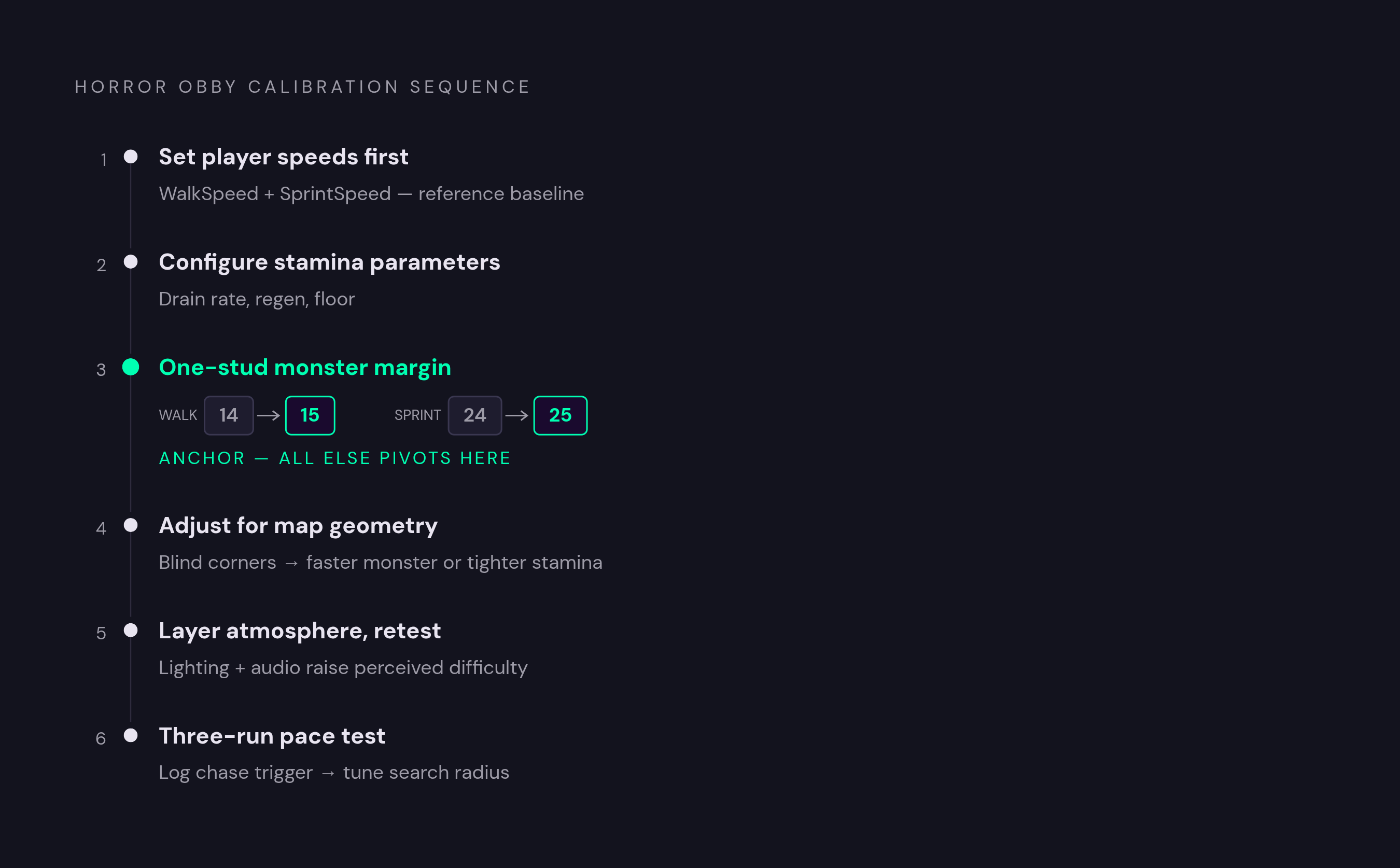
Calibration works best as a sequence rather than a pile of simultaneous adjustments, because each step depends on the one before it being locked down, and starting with monster speed before the player's baseline and stamina are set just guarantees redoing the work later.
The first move is fixing the player's base movement before touching the monster at all: decide WalkSpeed and SprintSpeed for the player first, since those numbers become the reference points everything else gets measured against. Third, set the monster's speed one stud above the player's WalkSpeed and one stud above the player's SprintSpeed as a starting baseline: a walker at 14 gets a monster at 15, a sprinter at 24 gets a monster at 25, matching what developers converge on in practice, and everything from there gets adjusted from that starting point.
From that baseline, the fourth move is adjusting for map geometry and how far the monster can actually perceive: a large map thick with blind corners calls for a faster monster or a tighter stamina pool, while a small, mostly linear map can tolerate a slightly wider margin in the player's favor, since corners and obstacles are already doing friction work on the monster's behalf. Fifth, atmosphere gets layered in before testing speed again, dimming the lighting, adding audio cues, locking in the monster's visual design, and then playtesting the result, since perceived difficulty often jumps upward at this stage, revealing that a speed which felt too slow in a lit, silent test room is plenty threatening once the atmosphere is actually doing its job. Sixth and last, test for pacing rather than difficulty alone: run the game three separate times and track when the chase actually triggered in each run. A chase that never kicks in until deep into the session means the monster's search radius needs tightening. A chase that fires off almost immediately means the player never got a fair shot at learning the hiding mechanic before being tested on it.
Developer discussion of ability balancing follows the same sequencing logic, since ability timing and cooldowns only got analyzed once the movement baseline was already locked in: abilities operate inside the speed relationship. That's the whole method in miniature: small adjustments, single-stud increments, and a playtest after every single change. That repeatable discipline, more than any one number, is what separates a horror obby players come back to from one they quit after the first chase.